

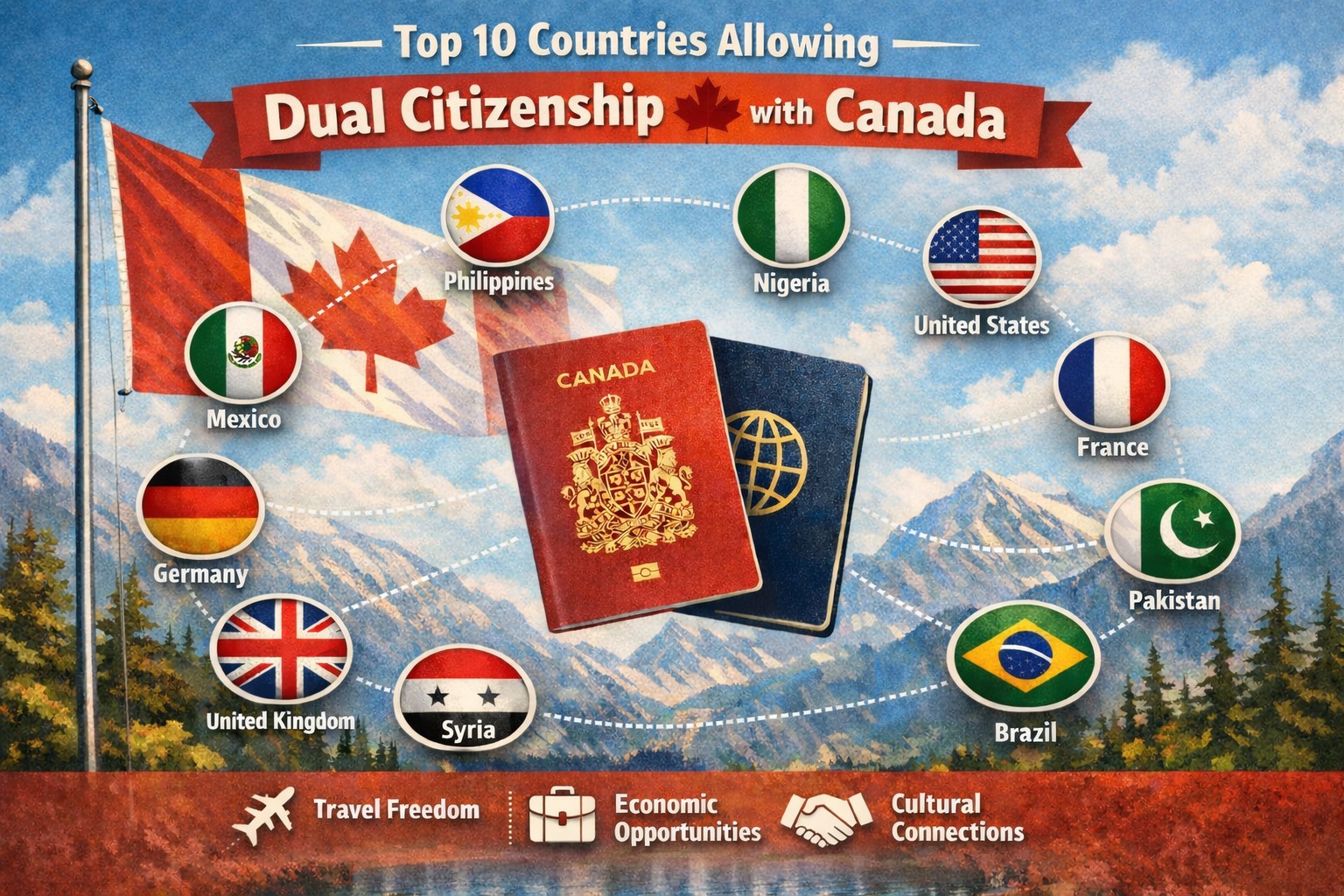
Dual Citizenship with Canada | Top 10 Countries That Allow It
Canada is one of the most welcoming countries in the world when it comes to immigration and citizenship. One of the biggest advantages for newcomers is that Canadian law fully recognizes dual and multiple citizenships. This means you can become a Canadian citizen without being forced to give up your original nationality.
However, whether you can legally hold two passports depends not only on Canadian law but also on the rules of your home country. Some countries—like India, China, and Iran—do not permit dual citizenship and require renunciation. Others allow it freely or under certain conditions.
In this guide, we’ll explore the top 10 source countries for new Canadian citizens in 2025 that allow dual citizenship with Canada. We’ll also highlight the restrictions, benefits, and important considerations for each nationality.
Philippines
- Natural-born Filipinos can retain their citizenship after acquiring Canadian nationality under Republic Act 9225.
- Children born abroad to Filipino parents are automatically dual citizens by birth.
- To formalize, parents must report the child’s birth to a Philippine consulate.
This makes Canada a popular destination for Filipino families, as they can enjoy the benefits of both a Canadian passport and their original nationality.
Nigeria
- Nigerians by birth or descent can keep their nationality after becoming Canadian citizens.
- Naturalized Nigerians must renounce their citizenship if they pursue Canadian citizenship.
- Dual nationals must use their Nigerian passport when entering or leaving Nigeria.
This rule ensures compliance with Nigerian immigration law while still allowing access to Canadian rights and privileges.
United States
- The US allows dual citizenship with Canada without restrictions.
- US citizens must enter and exit the US using a US passport.
This is one of the most straightforward arrangements, making Canada–US dual citizenship highly attractive for professionals, students, and families who move across the border.
France
- France has permitted dual citizenship since 1973.
- No restrictions or renunciation required.
French nationals can freely enjoy the benefits of Canadian citizenship while maintaining their European Union rights.
Pakistan
- Under the Pakistan Citizenship (Amendment) Bill 2024, Pakistanis can now hold dual citizenship with Canada.
- Applies to both naturalization and citizenship by descent.
This recent change is a major win for Pakistani immigrants, especially given Canada’s large Pakistani diaspora.
Brazil
- Brazil recognizes dual citizenship without conditions.
- Consular protection may be limited for dual nationals.
Brazilian citizens can easily integrate into Canadian society while keeping ties to their homeland.
United Kingdom
- UK citizens can hold dual citizenship with Canada.
- Dual nationals cannot seek British diplomatic help while in Canada.
This arrangement is particularly beneficial for those who want to maintain access to both Canadian healthcare and UK travel rights.
Germany
- Since June 27, 2024, Germany allows dual citizenship with Canada.
- Previously, German nationals lost citizenship unless exceptions applied (e.g., EU states, descent, or special permission).
This reform has opened doors for thousands of German immigrants in Canada who previously faced tough choices.
Syria
- Syria permits multiple citizenships.
- Dual nationals are treated as Syrian citizens first in legal and diplomatic matters.
While Syrian nationals can hold Canadian citizenship, they should be aware of how Syrian law prioritizes their original nationality.
Mexico
- Mexico has allowed dual citizenship since 1998.
- No restrictions or renunciation required.
Mexican nationals benefit from one of the most flexible dual citizenship arrangements, making Canada a top destination for migration.
Pathways to Canadian Citizenship
There are three main ways to become a Canadian citizen:
Citizenship by Birth
- Any child born in Canada automatically becomes a citizen.
- Exceptions apply for children of foreign diplomats.
Naturalization
Permanent residents can apply after living in Canada for 1,095 days (3 years) within the past 5 years.
Requirements include:
- Filing taxes if required
- No serious criminal record
- Passing the Canadian citizenship test (ages 18–54)
- Demonstrating English or French proficiency (CLB 4+)
The process ends with a citizenship ceremony.
Citizenship by Descent
Bill C-3 (December 15, 2025) changed the rules:
- For those born abroad before Dec 15, 2025 → No generation limit; citizenship flows through ancestry.
- For those born abroad after Dec 15, 2025 → Canadian parent born abroad must prove a substantial connection (3 years of physical presence in Canada).
Why Dual Citizenship Matters
Holding dual citizenship offers significant advantages:
- Travel freedom: Access to two passports expands visa-free travel options.
- Economic opportunities: Ability to work, study, and invest in both countries.
- Cultural ties: Maintain strong connections to heritage while enjoying Canadian rights.
- Security: Canadian citizenship provides access to healthcare, education, and social benefits.
Final Thoughts
Canada’s progressive stance on dual citizenship makes it one of the most attractive destinations for immigrants worldwide. Whether through naturalization, descent, or birth, nationals from countries like the Philippines, Pakistan, the US, and the UK can enjoy the benefits of holding both a Canadian passport and their original nationality.
For anyone considering immigration, understanding your home country’s rules is just as important as knowing Canada’s. With the right pathway, you can secure a future that blends opportunity, freedom, and cultural identity.